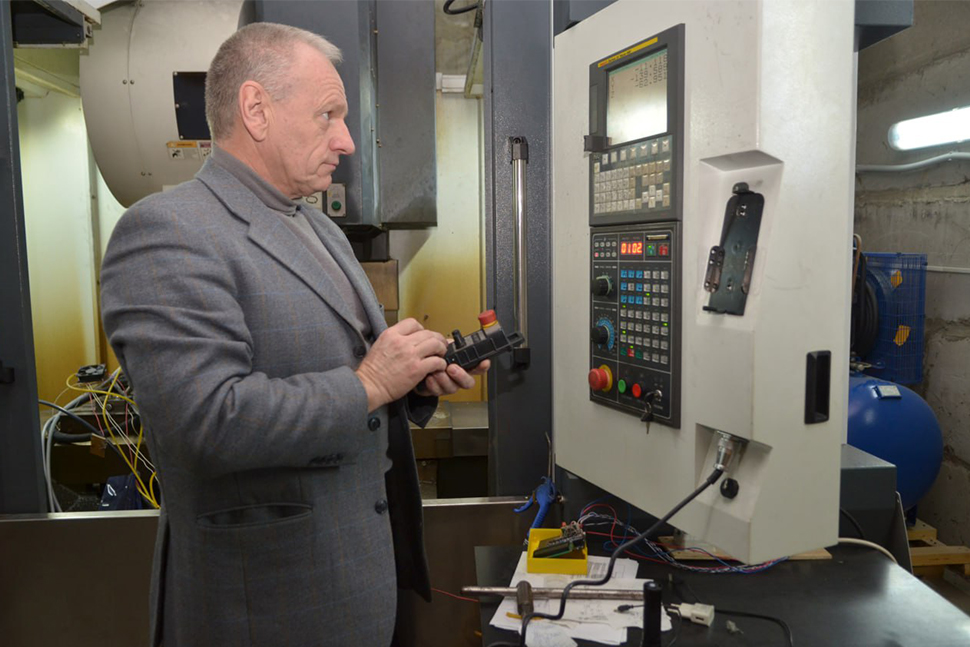
Penza State University scientists developed a unique technology for the production of powder from refractory and heavy alloys based on tungsten and tungsten carbide with spherical particles. The breakthrough discovery will help to produce high-quality metal-cutting tools in our country. Scientists have received patents for the invention.
The implementation of the project became possible thanks to the support of the Ministry of Education and Science of Russia. A stand was made at the university, which has no analogues in Russia -- a compact reactor suitable for embedding in the working area of a production line.
PSU scientists continue to work on the creation of a full cycle of metal-cutting tools production. It is in demand at the enterprises of mechanical engineering, military-industrial complex, aerospace industry, and instrument making. The company for the production of hard alloy products, STM Technology, and Virial LLC, leading Russian company in this field, have already shown interested in the development.
Currently, there is no metal-cutting tool in Russia that can fully compete with foreign analogues. The problem is the lack of technology for producing powders with spherical particles. It is with their help that tools are made, for example, in China, the USA, and other countries. In Russia, grinding powder with a comminuted form is used for these purposes.
Such raw materials do not allow the production of metal-cutting tools with high quality characteristics. The comminuted "flour" is baked arbitrarily, and the final product quality suffers. The spherical shape allows the particles to sinter more tightly.
Scientists from Penza State University have proposed a simple and original solution. The primary raw materials (heavy alloys based on tungsten carbide and heat-resistant steel) are placed in an electric arc, where a plasma channel with a temperature of up to 12 thousand degrees Celsius is formed. The material falling into this channel melts. Then the melt is sprayed using centrifugal forces. The output is a powder with spherical particles – a necessary raw material for the manufacture of high-quality metal cutting tools. The biggest difficulty is to determine the arc modes and hold them. It is necessary to set well-defined parameters of current, voltage and very precisely adjust the speed of rotation and convergence of the electrodes.
"It is necessary to "break" the melt and get very fine particles. Large ones are easy to get, small ones are more difficult." said Aleksandr Zverovshchikov, project manager, Doctor of Technical Sciences, Head of the Department of Technologies and Equipment of Mechanical Engineering of PSU.
In addition, the development of Penza scientists will allow to implement PIM technologies. It will become much easier to obtain metal or ceramic products of a complex profile with a minimum amount of material waste (1-2%).
A powder with a spherical shape has particle sizes ranging from 2 to 5 micrometers. This allows them to be used in a variety of fields, for example, when creating structural products (plain bearings, high-loaded parts, assemblies, etc).
The obtained test batches of powder are currently undergoing research at the University of Rostov-on-Don. According to Aleksandr Zverovshchikov, five samples were sent for pilot tests.
Photo provided by the PSU press service.
PSU Scientists Develop Technology for Production of Powder from Refractory and Heavy Alloys
Society
15.06.2026
Aleksandr Kurenkov Thanks Oleg Melnichenko for Attention to EMERCOM System
Society
16.06.2026
Governor Highly Praised New Baby Food Production Line at Penza Dairy Plant