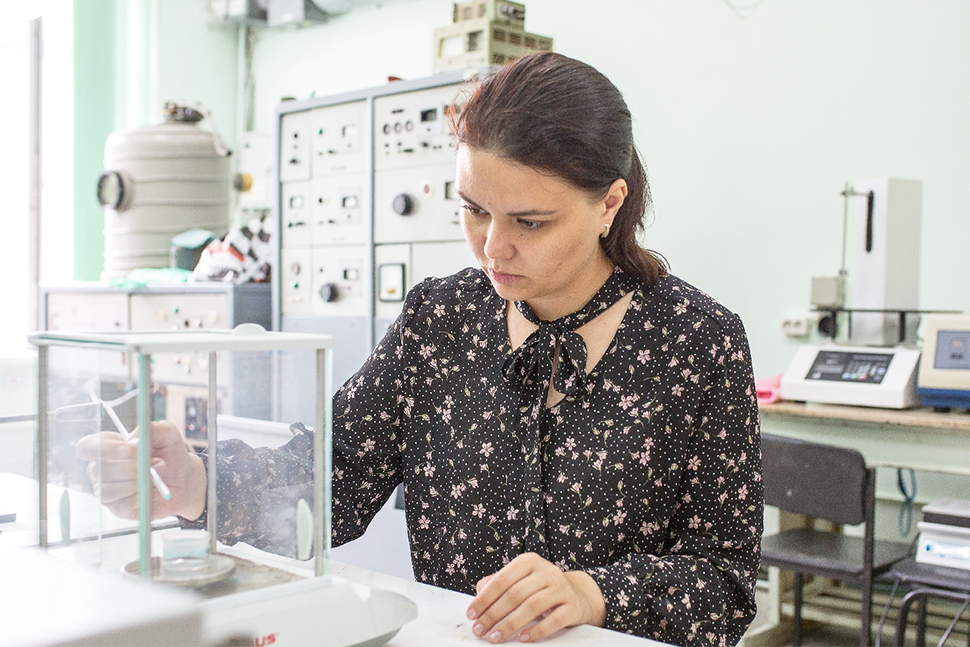
At Penza State University, scientists conducted a study on the modification of the surface properties of zinc oxide-based nanomaterials using a combination of different types of treatments. The developed technology will be widely used in alternative energy, solar cells, nanogenerators, gas sensors, and light-emitting diodes.
According to Igor Pronin, head of the scientific group, Doctor of Technical Sciences, Head of the Department of Nano- and Microelectronics at PSU, in the study they control the structure of zinc oxide powders, which is used in a wide range of applications, ranging from sensors to piezo generators, solar cells, and transparent conductive electrodes.
"One of the most important tasks of nanotechnology is to develop approaches for flexible management of the nanoarchitecture of the surface and volume of materials. In our study, we showed for the first time that a combination of different types of treatments of semiconductor oxide powders leads to a surface modification that is unattainable by individual methods. As methods, we use thermal annealing in vacuum, mechanical grinding in a planetary mill, and irradiation with an electron beam," the scientist explained.
At this stage of the research, the results are published in the prestigious international journal "Nanomaterials", which is included in the first quartile of the Web of Science database. Scientists from St. Petersburg State University, St. Petersburg Electrotechnical University "LETI" and other universities took part in the joint work. Employees of the Research Institute of Electronic and Mechanical Devices (NIIEMP) became interested in the project, they assume that the technology proposed by the PSU scientific group will be used to produce varistor powder and varistors based on zinc oxide.
Penza scientists were among the first to apply a combination of three factors to modify zinc oxide powder (grinding, annealing and irradiation). The technology is applied depending on the purpose of using the material — new types of defects appear, which affect new properties. The material is further used to create specific devices. According to scientists, before this scientific study, it was not possible to achieve certain surface parameters. It is the combination of three factors that serves to achieve the desired result.
"The peculiarity of this work is that we have established for the first time that a combination of different methods for the final result is not achievable with the separate use of these methods. Synergy produces new things," Igor Pronin stressed.
The study continues, the powder has already passed all the necessary tests and studies, laboratory samples of varistors have been made on its basis (they are used both in high-voltage installations up to 20 kV and in low-voltage installations from 3 to 200 V as a voltage limiter). PSU scientists together with NIIEMP employees plan to implement zinc oxide-based devices in the real sector of the economy. Currently, semiconductor oxide powder is already used to create gas sensors, as a catalyst for chemical processes, and in photocatalysts (utilization of greenhouse gases and its subsequent processing into fuel).
PSU Scientists Are First to Study Synergistic Effect of Various Types of Semiconductor Oxide Powder Treatments

Society
15.06.2026
Aleksandr Kurenkov Thanks Oleg Melnichenko for Attention to EMERCOM System

Society
16.06.2026
Governor Highly Praised New Baby Food Production Line at Penza Dairy Plant